
UK Card Shows & Events: Where Collectors Actually Meet
UK card shows explained: how the circuit works, what to expect at your first event, haggling etiquette and how to spot good deals. Meet the hobby.

If you’ve tried to buy a booster box at retail price lately, you already know the headline: the Pokémon card market in 2026 is running hot. Products sell out in minutes, grading queues are long, and cards your nan would recognise are trading like small assets.
But ‘everything is mental’ isn’t analysis. Underneath the sell-out screenshots there are real mechanics — demand drivers, supply decisions, and clear winners and losers — that actually explain what’s going on.
Here’s our honest read from behind the counter: what’s happening, why, and what we think the next twelve months look like. As always, treat this as informed opinion from a shop that lives in this market daily — not financial advice.

Three observations define the market at the time of writing:
Price-wise, aggregate market trackers such as TCGplayer paint a picture of sustained strength with rotation — money moving between segments rather than flooding in and out of the hobby as a whole.
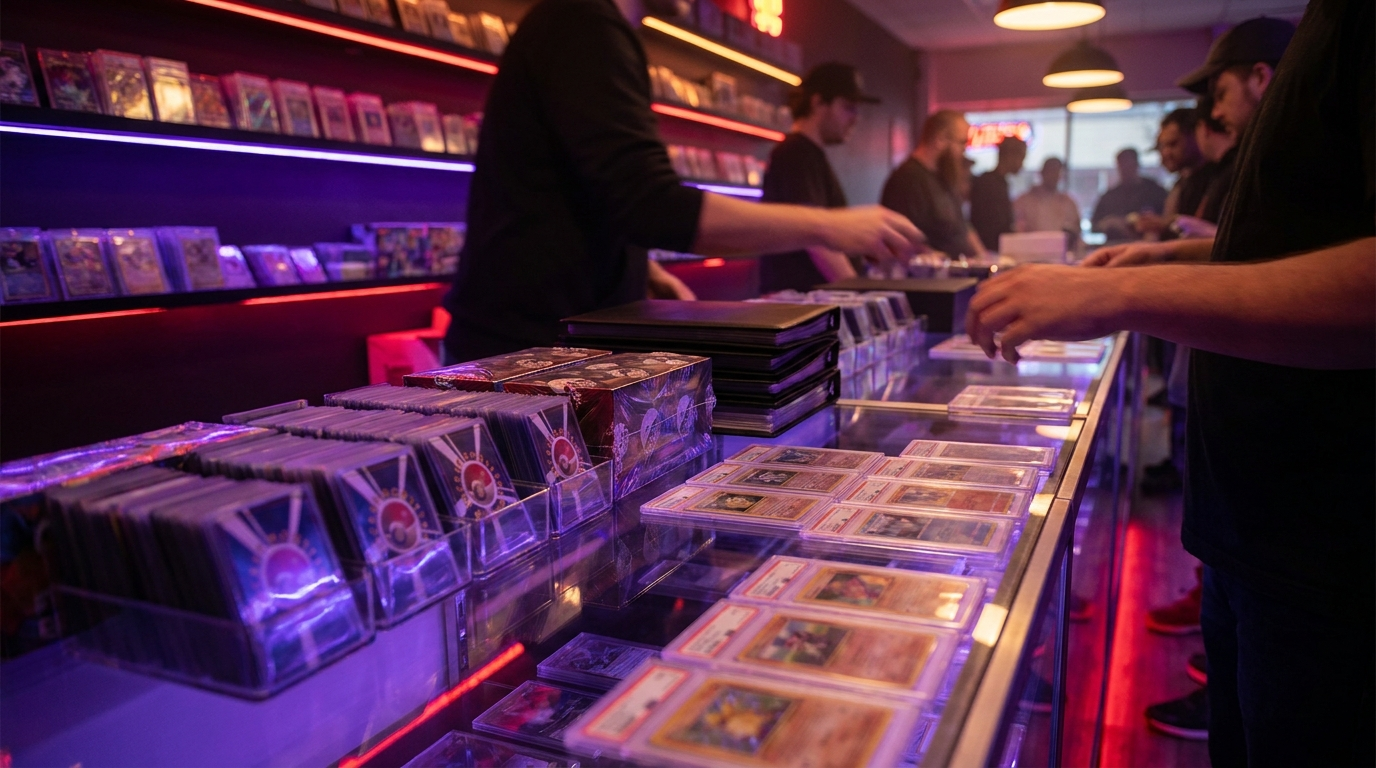
The UK picture has its own flavour. Allocation for hot products here has been tight, so release weeks are frantic and restocks matter more than launch day. Marketplace pricing on scalped product runs ahead of what fair retailers charge, which means the spread between ‘shop price’ and ‘panic price’ is as wide as we’ve ever seen it — and patient UK buyers who wait for restocks have consistently done better than anyone paying resale in week one. Card shows and shop events, meanwhile, are busier than at any point in the hobby’s UK history, which tells you demand isn’t just online noise.
Pokémon turns 30 in 2026, and anniversary years are historically rocket fuel. The 25th anniversary’s Celebrations era showed the pattern: celebration products, reprint nostalgia, mainstream press coverage, lapsed fans returning. The 30th is following the script with bigger numbers. We’ve written up the wave in detail in our 30th anniversary collector’s guide.
The mobile game keeps introducing millions of people to card collecting mechanics — rarity tiers, chase art, completing sets — and a meaningful slice of those players graduate to physical cards. It’s the widest onboarding funnel the physical hobby has ever had.
Special Illustration Rares changed what people chase. Demand now concentrates on beautiful cards rather than just powerful or nostalgic ones, which keeps every new set relevant to collectors — not just players.
Grading has gone from niche to default for anything valuable, and that changes market behaviour: slabs are easier to trust, easier to sell and easier to obsess over, so more of the hobby’s money flows through graded channels. Layer on the content machine — box breaks, market commentary, pull-rate drama running around the clock — and you get a market that reacts faster, in both directions, than at any previous point. Hype cycles that once took months now play out in a fortnight. That speed is neither good nor bad in itself, but it punishes anyone making decisions from headlines rather than data.
Here’s the part that gets lost in the outrage posts: The Pokémon Company has been printing more cards than at any point in history, and things still sell out. Why?
Collector’s tip‘Sold out everywhere’ and ‘rare’ are not the same thing. Most modern sets get multiple print waves, and prices on singles typically ease as supply catches up. Patience is a market strategy.
Rotation is the story. Over the past year or so, the clearest winners have been: flagship special sets (Prismatic Evolutions above all), Japanese product — which more UK collectors now buy as their default — high-grade vintage, and premium Eeveelution and Pikachu chase cards. Sealed product from the tail end of Scarlet & Violet has also aged well as attention moved to the new era.
The losers are instructive too: over-printed mid-era sets with weak chase cards have drifted, bulk and low-tier hits remain near worthless, and some hyped ‘guaranteed winner’ products bought at peak resale prices are underwater versus what patient buyers paid weeks later. Chasing hype at its loudest moment remains the most reliable way to lose money in this hobby — a theme we explore properly in our honest look at Pokémon cards as an investment.
Watch outPaying resale prices in release week is the most reliable way to lose money in this market. UK allocation makes launches frantic, but the gap between shop price and panic price is as wide as we have ever seen it — and restocks have consistently rewarded the people who waited.
One more pattern worth naming: the middle has hollowed out. Truly premium cards and genuinely cheap fun both sell briskly, but mid-tier hits — the £8-to-£20 cards that are neither chase nor bulk — have been the softest segment, because new money skips straight from packs to the top of the checklist. If you’re selling, that tier is where patience matters most; if you’re buying for love rather than profit, it’s quietly where the bargains live.

Hedged appropriately — nobody knows, least of all people who claim to — here’s what we’re planning around:
The scenario we’d watch for: a genuine print-run catch-up. The Pokémon Company has responded to previous booms by printing heavily into demand, and if 2026’s waves land bigger than expected, resale premiums on recent product could deflate quickly even while the hobby itself keeps growing. That’s not a prediction — it’s a reason to avoid paying panic prices for anything that will plausibly be reprinted.
Our own approach at TCG Smiths is unchanged by the noise: stock what collectors actually want, price it fairly rather than to whatever the market will briefly bear, and reward regulars — 10 loyalty points per £1 — so that collecting through a hot market doesn’t feel like being farmed. You can see what that looks like in practice in our Pokémon range.
Distributors allocate stock rather than take open orders, fear of missing out compresses months of buying into release week, and resellers grab retail allocation to relist at markups. Print runs are actually larger than ever.
Nobody knows. The realistic risk is not a crash in the hobby but a deflation of resale premiums if print runs catch up with demand, which is why panic prices on reprintable product are the thing to avoid.
We are a card shop, not financial advisers. Flagship sets with era-defining chase cards have held demand best, but plenty of “can’t-miss” products bought at hype peaks are still underwater.
The 30th anniversary, TCG Pocket funnelling digital players into physical cards, art-first collecting around Special Illustration Rares, and grading becoming the default for anything valuable.
In the UK, waiting has consistently been the better deal. Sell-out day is rarely the last word, and restock pricing sits well below week-one resale.
The takeaway: 2026 is a genuinely strong market wearing a slightly silly hat. Buy what you love at prices you’d be happy with even if the market cooled, ignore the loudest voices in both directions, and let restocks do their work. For sober release-by-release updates — what’s landing, what’s worth it, what to skip — join our mailing list and we’ll keep you posted without the hype.
UK card shows explained: how the circuit works, what to expect at your first event, haggling etiquette and how to spot good deals. Meet the hobby.

Pokémon card trading is the best free fun in the hobby — until a bad trade stings. Value trades fairly, avoid scams online and trade with confidence.

Are Pokémon tins worth buying? We break down the tin line-up, mini tins vs full tins, the value maths and when a tin is genuinely the right buy.