
UK Card Shows & Events: Where Collectors Actually Meet
UK card shows explained: how the circuit works, what to expect at your first event, haggling etiquette and how to spot good deals. Meet the hobby.


Let us answer the question properly, because most content on this topic is written by people trying to sell you something. Are Pokémon cards a good investment? Honestly: they can be, they often are not, and anyone promising you returns is doing you a disservice. Cards are an unregulated collectibles market — closer to art and whisky than to an ISA — and they should be treated with exactly that mix of interest and caution.
We sell cards for a living, so you might expect the hype pitch here. You will not get one. What follows is the case for, the case against, what the last five years actually did, and the rules we genuinely follow with our own money.
One thing before we start: nothing here is financial advice. It is collectors talking honestly about a market we live in every day.

The bull case rests on real foundations. Demand is generational and global. Pokémon is the highest-grossing media franchise in history, with thirty years of fans — and the kids of 1999 are now adults with disposable income and nostalgia to spend. Every era’s children age into every era’s collectors.
Supply of the good stuff is genuinely finite. The Pokémon Company can reprint modern sets, but it cannot print more 1998 trophy cards, more 1st Edition Base Set, or more PSA 10s of anything — top-grade populations grow slowly and demand has historically grown faster. Vintage and true chase cards have shown long-term appreciation that has outrun inflation over multi-decade windows.
The market is transparent and liquid by collectibles standards: public sold prices on TCGplayer and eBay, population data from PSA, and millions of active buyers. Compared with art or wine, you can actually see what things trade for and sell within days.
There is a structural tailwind in 2026 specifically, too: the 30th anniversary has pulled lapsed collectors back into the hobby in numbers, and anniversary-era products have historically become collectible in their own right. Demand events of that scale do not happen every year — and while they inflate prices at the time, they also permanently widen the collector base that all future demand rests on.
Now the part the hype merchants skip. Modern print runs are enormous. Today’s sets are printed in volumes the hobby has never seen before, and The Pokémon Company reprints aggressively when demand spikes. Scarcity assumptions that held for 1999 product may simply not hold for 2026 product.
The market is a hype cycle. Prices are driven by sentiment, influencers and viral moments, and they correct hard — anyone who bought at the 2021 peak learned that expensively. Costs eat returns: grading fees, selling fees of 10–15%, postage, storage and insurance all come out of your margin. Condition risk is real: a damp shelf or a dinged corner can erase years of appreciation. And cards pay no income while you hold them — unlike shares or property, a box on a shelf earns nothing until the day someone pays more than you did.
Add scams — resealed boxes, weighed packs, fakes — and the honest summary is that this is a high-risk, high-knowledge market where casual money routinely loses to informed money.
Watch outNever buy cards with borrowed money, rent money, or money you might need inside two years. This is an unregulated collectibles market with no investor protection, no compensation scheme and no obligation on anyone to buy your cards back. The people who got badly hurt in the 2022 correction were almost never the ones who had bought carefully — they were the ones who had bought with money that was not really spare.
Liquidity also deserves honesty. Cards sell fast at market price; they sell slowly at the price you hoped for. The spread between what buyers pay and what sellers net — fees, postage, time, the occasional return — is real, and in a downturn the bid side of the market simply evaporates: everything still has a price, just not one you want. Anyone modelling card ‘returns’ without modelling exit costs is writing fiction, not finance.
The three main vehicles behave differently:
We compare the first two head-to-head in sealed vs singles if you want the deeper dive.
Collector’s tipWrite down what you actually paid, including postage and fees, the day something arrives. Collectors are remarkably good at forgetting their entry price and remarkably bad at calculating a real return without it — and a simple spreadsheet turns a vague feeling that a card ‘did well’ into a number you can act on.
If you insist on treating cards partly as an asset, the boring answer is a blend weighted by knowledge: slabs for the cards you understand deeply, a modest sealed shelf bought at retail for patience you can genuinely afford, and singles where your collector’s eye gives you an edge. What that blend should never include: borrowed money, rent money, or anything bought primarily because a video told you it was going up. This market has a long memory for hype and a short one for the people who bought it.
A compressed history, from memory and public sale data rather than crystal ball: the 2020–21 pandemic boom sent everything vertical — vintage slabs multiplied, modern sealed sold out everywhere, and celebrities buying boxes made the news. 2022 corrected it, hard in places; plenty of modern product fell well below its peak and hype-bought sealed went underwater. 2023–2025 rebuilt on genuine demand: Pokémon 151 and Prismatic Evolutions reignited the collector market, chase reverses like Master Balls created new scarcity tiers, and sell-through on strong sets became routine again. Now the 30th anniversary era is adding another wave of demand and another wave of hype-priced product — both at once.
The pattern across all five years: people who bought quality at sensible prices and held did fine; people who bought anything at any price during euphoria mostly did not. The product mattered less than the entry point. We keep a running read on conditions in our 2026 market overview.
Worth noting what did not happen in that window: the hobby did not die in the 2022 correction, as plenty predicted, and the strongest vintage cards recovered faster than almost anything modern. Quality proved durable; hype did not. That asymmetry is the closest thing to a reliable lesson the whole period offers.
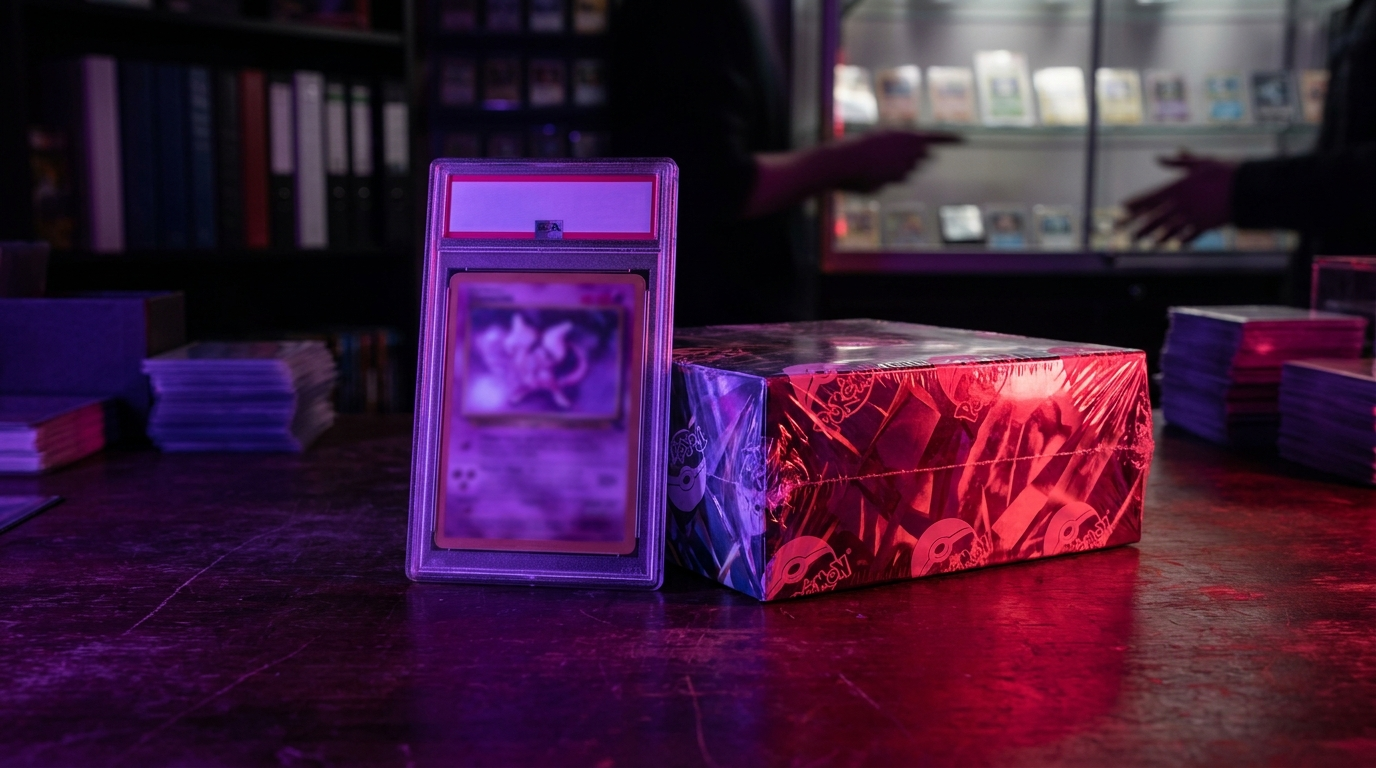
Collector’s tipOur house rules: only spend money you can afford to have locked up for years — or lose. Never buy above fair retail during hype. Prefer quality over quantity: one great card beats twenty mediocre ones. Buy what you would be happy to simply own if the market went nowhere. Count all costs — fees, grading, postage — before calling anything a profit. Store it properly, because condition is the asset. And diversify your life: cards should be a hobby line in your finances, not the plan.
None of this is exciting, which is rather the point. The most successful collector-investors we know are patient, boring and unemotional at exactly the moments the market is not.
Two of those rules do most of the work. Entry price forgives almost everything: a good product bought at fair retail can survive a market wobble, while the same product bought at double retail needs years just to break even. And time horizon is the honest filter — if you might need the money within two years, this market’s swings make it the wrong place for that money, full stop.
It is broader rather than safer — you get exposure to a whole set instead of a bet on one card. The trade-offs are real: sealed is bulky, fragile, faked, and modern sealed faces the reprint question directly. Buy at fair retail or the maths never works, however long you hold.
They are the most liquid, because the slab removes the condition argument and buyers will trade them sight-unseen. You pay the grading premium up front, though, and grade populations only ever grow — so the same card gets marginally less scarce at that grade every year.
Longer than feels comfortable. Chase singles often dip after a set’s hype window as supply floods in, then recover only if the card proves genuinely iconic. If there is any chance you will need the money within two years, this market’s swings make it the wrong home for it.
No — and that is one of the more useful things the period taught us. Plenty of hype-priced modern product went underwater and stayed there, while the strongest vintage cards recovered faster than almost anything else. Quality proved durable; hype did not.
Paying above fair retail during a hype window, then modelling a return that ignores exit costs. Selling fees of 10–15%, postage, grading and storage all come out of the margin, and any ‘return’ calculated without them is fiction rather than finance.
Here is our real answer to the question. The people who do best in this hobby, financially and otherwise, are collectors first: they know the sets, they feel the market because they live in it, and if prices stagnate for five years they still own a collection they love. The people who do worst arrive purely for returns, buy at peaks, store things badly and sell in panics.
If you take one number away from this article, make it this: the all-in cost of a round trip — buying, grading where relevant, storing, selling — routinely consumes 20–30% of a card’s value. Appreciation has to clear that bar before you make a penny, which is exactly why ‘buy what you love’ is not sentimentality. It is the only strategy where you win even when the market does not move.
So: can Pokémon cards appreciate? Demonstrably. Should they be your investment strategy? No — and we say that as people whose shelves are full of them. Buy well, hold what you love, and let any upside be the bonus. If you want honest market commentary rather than hype — what is selling, what is overpriced, what we are genuinely excited about — that is exactly what the TCG Smiths mailing list is for.
UK card shows explained: how the circuit works, what to expect at your first event, haggling etiquette and how to spot good deals. Meet the hobby.

Pokémon card trading is the best free fun in the hobby — until a bad trade stings. Value trades fairly, avoid scams online and trade with confidence.

Are Pokémon tins worth buying? We break down the tin line-up, mini tins vs full tins, the value maths and when a tin is genuinely the right buy.