
UK Card Shows & Events: Where Collectors Actually Meet
UK card shows explained: how the circuit works, what to expect at your first event, haggling etiquette and how to spot good deals. Meet the hobby.


Almost every valuable card that loses its value does so at home. Not in the post, not at a show — on a desk, in a drawer, in a ring binder. Learning how to store Pokémon cards properly is the cheapest insurance policy in the hobby, and it takes one evening to get right.
The good news is that card storage is a solved problem. Collectors have spent decades working out what damages cardboard and what protects it, and the equipment involved is inexpensive — most of it costs less than a single booster pack.
This guide covers the full stack: sleeves, rigid protection, binders, sealed product and the environmental stuff — light, heat and humidity — that quietly does more damage than any of them.
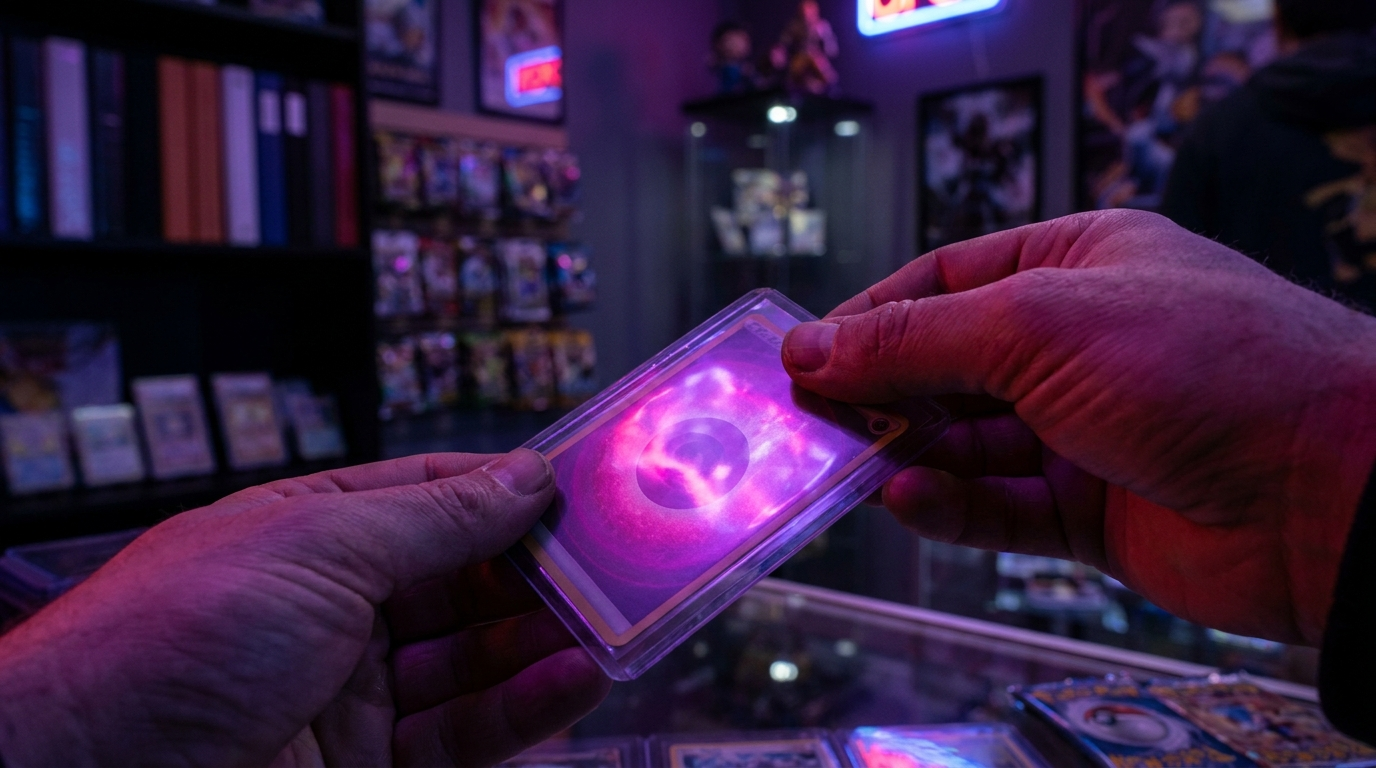
Card condition is brutally binary in this hobby. As we cover in our card condition guide, the difference between Near Mint and Moderately Played can be a small cluster of edge whitening — and a 50%+ difference in price. Damage is cumulative and irreversible: every unsleeved shuffle, every stack on a desk, every week in direct sunlight takes a little off, and nothing puts it back.
Storage matters even if you never plan to sell. A collection is more enjoyable when the cards still look the way they did when you pulled them, and if you ever do decide to grade something, the storage decisions you made years earlier will set the ceiling on the grade.
Every card you care about goes in a sleeve. The base layer is the humble penny sleeve — a thin, soft polypropylene sleeve costing pennies each. It stops fingerprints, surface scratches and edge scuffs, which between them account for most of the wear on modern cards.
For cards heading into rigid holders, many collectors double sleeve: a snug perfect-fit sleeve first (often inserted upside down to seal the card), then a standard sleeve over the top. It is overkill for bulk and exactly right for hits. We break the whole topic down in our card sleeves guide, but the short version is: penny sleeves for everything, perfect fits under sleeves for the cards that matter.
Sizing is mercifully simple: Pokémon cards are standard size (63 × 88 mm), so any standard trading card sleeve fits. Buy in bulk — a hundred penny sleeves costs less than a booster pack — and re-sleeve anything that arrives in a scuffed or dirty sleeve, because grit trapped inside a sleeve does more surface damage than no sleeve at all. Keep a small stack at your pack-opening station too: the best moment to sleeve a good pull is the moment it leaves the pack, before it ever touches the table.
Rigid protection stops bends, and there are three main options. Whichever you choose, always sleeve the card first — a bare card can scratch against the rigid plastic.
| Protector | What it is | Best for |
|---|---|---|
| Toploader | Hard PVC case you slide a sleeved card into | The everyday standard for storing and posting individual cards |
| Semi-rigid (card saver) | Flexible-but-firm holder that grips the card more snugly | Grading submissions, and tight, safe stacking |
| One-touch magnetic case | Two-piece acrylic with UV resistance, closed with a magnet | The premium display choice for your best raw cards |
A sensible hierarchy: bulk stays sleeved in boxes, decent hits go in toploaders, grading candidates sit in card savers, and your favourites live in one-touches on the shelf.
For bulk that does not merit individual protection, proper cardboard storage boxes — the long, card-width ones every accessory brand makes — beat shoeboxes comprehensively: they hold cards snugly on edge without warping, stack safely and cost a couple of pounds each. We walk through organising an entire collection, bulk included, in our storage solutions guide.
Binders are the best way to enjoy a collection, and the worst way to damage one if you buy the wrong type. Two rules do most of the work. First, no ring binders — the rings press into pages and leave dents and indentations on cards, and cards can fall out when pages are turned. Second, side-loading pockets only — top-loading pages let cards slide out when the binder is upright on a shelf.
What you want is a zip-closure binder with fixed, side-loading pages — the style sold by every reputable accessory brand. Store binders upright like books, never stacked flat, and do not overfill pockets with double-sleeved cards; pressure over time can leave impressions. We go deeper on brands, sizes and layouts in our binder buying guide, and you will find our current range of binders and pages in the accessories section.
One organisational habit pays for itself: leave empty pockets for growth. However you sort — by set, by type, by favourites — repeatedly shuffling cards between pages to make room is precisely the handling the binder was meant to prevent.

Sealed boxes and ETBs need surprisingly little: keep them in the dark, keep them dry, and resist the urge to shrink-wrap them yourself (aftermarket wrap can trap moisture and raises reseal questions when you sell). Store boxes upright, do not stack anything heavy on top — crushed corners are the classic sealed-product injury — and if a box came with a factory case or outer carton, keep it.
For long-term holds, some collectors add acrylic cases for display pieces and silica gel sachets in storage tubs. Both are cheap and worthwhile.
Collector’s tipWrite the date on a slip of paper whenever you drop a silica gel sachet into a storage tub. Sachets stop absorbing after a few months, and a spent one gives you false confidence while the humidity creeps back up. Set a reminder to swap them twice a year — it costs pennies and it is the single most-forgotten step in long-term storage.
What matters most is the location: a cupboard or interior-wall shelf beats a loft, garage or conservatory every single time.
The environment damages more collections than handling does. Three things to control:
Grading companies keep their vaults cool, dark and dry for a reason — PSA publishes care guidance along the same lines, and the general advice from the official Pokémon TCG site on looking after cards matches it: treat cards like photographs, not toys.
Watch outThe loft is where collections go to die. UK loft temperatures swing from below freezing to over 40°C across a year, humidity spikes every time the weather turns, and the damage — warped cards, curled sealed wrap, foxing on box art — is invisible until the day you go up to fetch something. Garages and conservatories are the same story. An interior-wall cupboard costs nothing and solves all of it.
Not individually, no. Bulk can live on edge in proper cardboard storage boxes, which hold cards snugly without warping. Reserve sleeves for anything you would be annoyed to see scratched — and sleeve the moment a card leaves the pack rather than after it has spent an evening on the table.
For hits, yes. A snug perfect-fit sleeve, often inserted upside down to seal the card, then a standard sleeve over the top, keeps dust and moisture out from every direction. It is overkill for bulk and exactly right for the cards you would replace if they were damaged.
A normal indoor 45–55% relative humidity. Below that and cards can become brittle; above it and cardboard swells, warps and eventually grows mould. A £10 hygrometer removes all the guesswork and pays for itself the first time it tells you something you did not expect.
Yes, and an airtight tub with a silica gel sachet is genuinely good long-term storage — provided the tub lives somewhere with a stable temperature. Sealing damp air inside a tub in a cold garage is worse than leaving the cards on a shelf indoors.
No. Aftermarket wrap can trap moisture against the box, and it immediately raises reseal questions when you come to sell. Keep sealed product upright, in the dark, with nothing heavy stacked on top, and hold on to any factory case or outer carton it came in.
If all of this sounds like a lot, here is the whole system in one paragraph: penny sleeves on everything worth more than pennies; toploaders or card savers on the hits; a zip-closure, side-loading binder for the cards you actually look at; cardboard storage boxes for bulk; sealed product upright in a cupboard; and everything on an interior wall, out of sunlight, at normal room humidity. Total outlay for a typical collection: £30–£50. Value protected: potentially everything you own.
The takeaway: sleeve everything you value, put rigid protection on the hits, use a zip binder with side-loading pages, and keep the whole lot dark, dry and at stable room temperature. Do that and your collection will still be crisp in twenty years. If you need to build out your storage kit, our accessories range covers the essentials — and as with everything we stock, we only sell the storage gear we would use on our own collection.
UK card shows explained: how the circuit works, what to expect at your first event, haggling etiquette and how to spot good deals. Meet the hobby.

Pokémon card trading is the best free fun in the hobby — until a bad trade stings. Value trades fairly, avoid scams online and trade with confidence.

Are Pokémon tins worth buying? We break down the tin line-up, mini tins vs full tins, the value maths and when a tin is genuinely the right buy.