
UK Card Shows & Events: Where Collectors Actually Meet
UK card shows explained: how the circuit works, what to expect at your first event, haggling etiquette and how to spot good deals. Meet the hobby.


Long before grading, chase sets and price charts, this hobby was two kids swapping cards in a playground — and honestly, Pokémon card trading is still the purest fun in it. A good trade costs nothing, upgrades both collections and usually starts a friendship. A bad one leaves you staring at your binder wondering how you got talked out of your best card.
The difference between the two is process, not luck. This guide covers how to value a trade fairly, the etiquette that keeps in-person trades friendly, how to trade online without being scammed, and the habits — proof, tracking, cooling-off — that protect you when a trade goes wrong.

Every solid trade rests on one boring foundation: both sides know what the cards are worth. Before agreeing anything, look up recent sold prices — not asking prices — on TCGplayer and eBay completed listings. Asking prices are hopes; sold prices are facts. Our card values guide walks through this in detail if price-checking is new to you.
Then adjust for the thing traders most often fudge: condition. A near-mint copy and a played copy of the same card can differ in value by half or more, so inspect every card in good light before you agree — edges, corners, surface, the lot. If you cannot yet grade condition by eye, our condition guide is the ten-minute read that pays for itself for the rest of your collecting life. A few more rules of thumb:
Collector’s tipPrice-check both sides of the trade together, on the same site, on the same day. It turns an awkward negotiation into a shared task — and it removes any suggestion afterwards that one of you knew something the other did not.
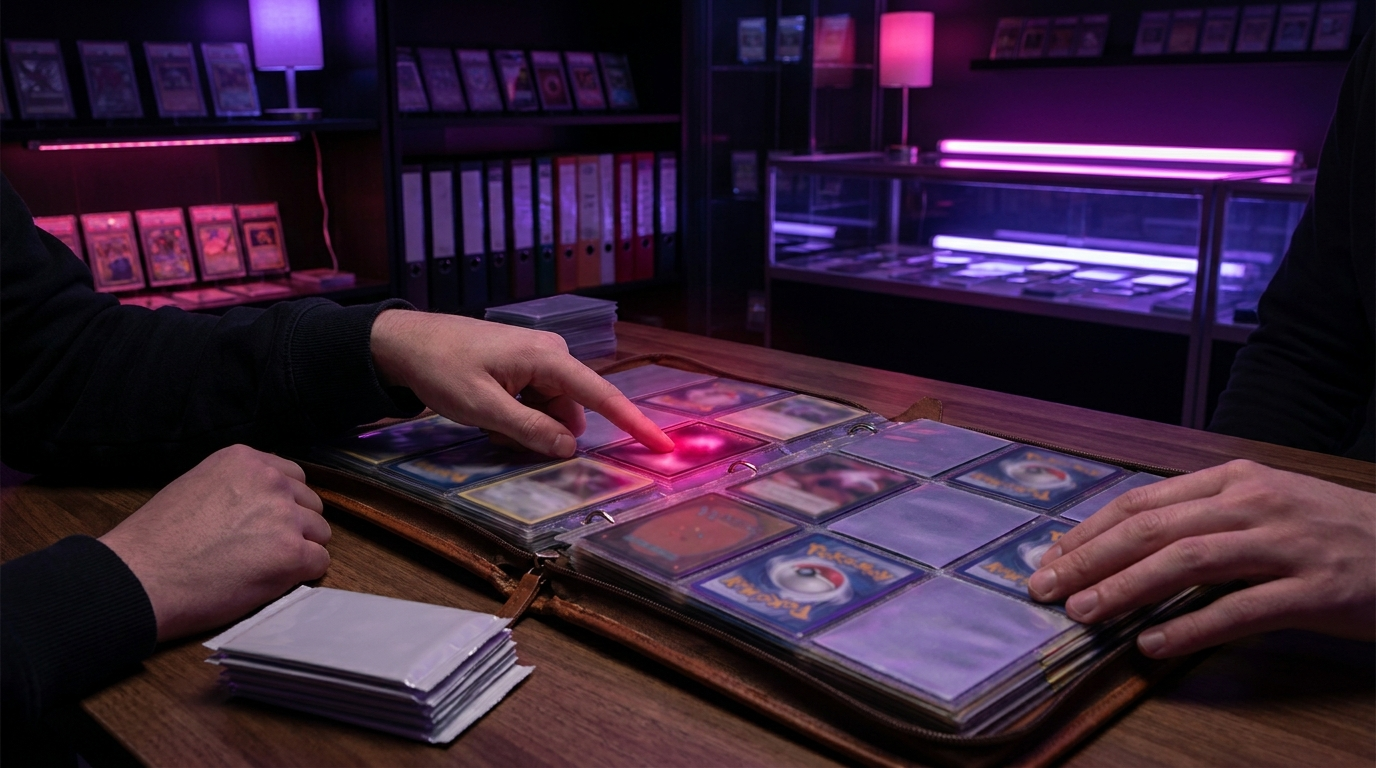
Face-to-face trading — at shops, meetups and card shows — is where Pokémon card trading runs on unwritten rules, so let’s write them down once. Ask before touching anyone’s cards, and handle them by the sleeves. Never pressure, rush or ‘hard sell’ a trade, and never dogpile a kid or newcomer with a lopsided offer — the community has a long memory for people who do. Both parties check every card, both say the deal out loud before cards change hands, and once done, a deal is done. If someone declines, thank them and move on; today’s ‘no’ is often next month’s better trade. Trade fairly with a twelve-year-old and their parent remembers your name for years, in the best way.
Online trading opens up the whole country’s binders — and every scammer in it. The dangers are well known: fakes photographed instead of the real card, condition hidden in blurry photos, and the classic no-send, where your card goes out and nothing comes back. Protect yourself with structure:
Watch outThe no-send is the most common online scam, and it nearly always looks the same: a new account, a move from the public thread into private messages, and pressure to post first because they are ‘heading to the post office now’. Anyone rushing you out of a public record is telling you exactly what they plan to do.
A worked example makes the process concrete. Say you are trading a modern illustration rare for two mid-value holos with someone you met in a collectors’ group. You check their post history and vouches, both of you post timestamped photos of your cards, you agree the trade in writing in the thread (not in private messages, so there is a public record), and you both post the same day with tracking shared. Total extra effort: perhaps fifteen minutes. That fifteen minutes is the entire difference between the trades that go wrong online and the ones that never do.
When a trade ships, evidence is everything. Photograph and video the cards going into the package, including the sealed envelope with the address visible. Ship in rigid protection — sleeve, toploader, between cardboard — because a bent card voids the whole exercise. Always use tracked postage, and for anything valuable, use a service insured to the card’s real value; standard post compensation is trivial. Share tracking numbers both ways the moment you post. It sounds like paperwork for a hobby, and it is — right up until the week it saves you.
Collector’s tipFor high-value shipments, photograph the package at the counter as you hand it over, receipt in frame. If a parcel is lost or damaged, claims move far faster when you can prove exactly what was sent, how it was packed and when it entered the postal system.
Two informal conventions smooth over the rough edges. A cooling-off agreement — either side can pull out before cards are posted or handed over — costs nothing and prevents most regret-fuelled disputes. Trade-backs — offering to reverse a trade shortly afterwards if one side is unhappy — are a courtesy, not an obligation, but offering one occasionally marks you out as someone worth trading with. What kills goodwill is retrospective renegotiation: discovering a card went up in price last week is not grounds to demand it back. Prices move; deals stand.
Here is the long game: in every Pokémon card trading community, a handful of names come up over and over as people everyone trusts, and those people get the best trades in the group — first refusal on new pulls, benefit of the doubt in disputes, offers that never reach the open market. Getting there is unglamorous: photograph honestly, grade condition conservatively, post promptly with tracking, communicate clearly, and keep your word even when it costs you. Collect vouches and feedback as diligently as you collect cards. Reputation compounds like interest, and unlike your chase cards, nobody can pull it out of a pack.
Compare recent sold prices for both sides, then adjust honestly for condition. If the totals land within roughly ten per cent of each other and neither of you is trading on count rather than value, it is a fair trade.
Yes, if you add structure. Trade inside established communities with feedback and moderators, agree the deal in a public thread, ask for photos of the actual cards with a handwritten username and date, and post tracked on the same day.
A trusted community member who receives both sides of a trade and forwards them on once everything checks out. It costs a little time and postage, and it removes almost all of the risk on high-value or first-time trades.
Sleeve the card, seat it in a toploader, sandwich that between cardboard and send it in a rigid envelope. Use tracked postage, insure anything valuable to its real value, and film the packing process before it is sealed.
Before anything has been posted or handed over, yes — a cooling-off is normal courtesy and saves a lot of regret. Once cards have changed hands the deal stands, and a card rising in price afterwards is not grounds to reopen it.
The takeaway: check sold prices, judge condition ruthlessly, trade where reputations matter, and ship like the package is worth more than it is. Do that and trading becomes what it always should have been — the best free fun in the hobby. If you have questions about a trade, or you are ever unsure whether a card someone is offering you is genuine, our FAQ covers the common ones and you can always drop us a line — we are happy to help, no purchase required.
UK card shows explained: how the circuit works, what to expect at your first event, haggling etiquette and how to spot good deals. Meet the hobby.

Are Pokémon tins worth buying? We break down the tin line-up, mini tins vs full tins, the value maths and when a tin is genuinely the right buy.

Pokémon TCG Pocket vs physical cards compared: costs, collecting, trading and the experience itself. Find out which side of the hobby fits you best.