
UK Card Shows & Events: Where Collectors Actually Meet
UK card shows explained: how the circuit works, what to expect at your first event, haggling etiquette and how to spot good deals. Meet the hobby.

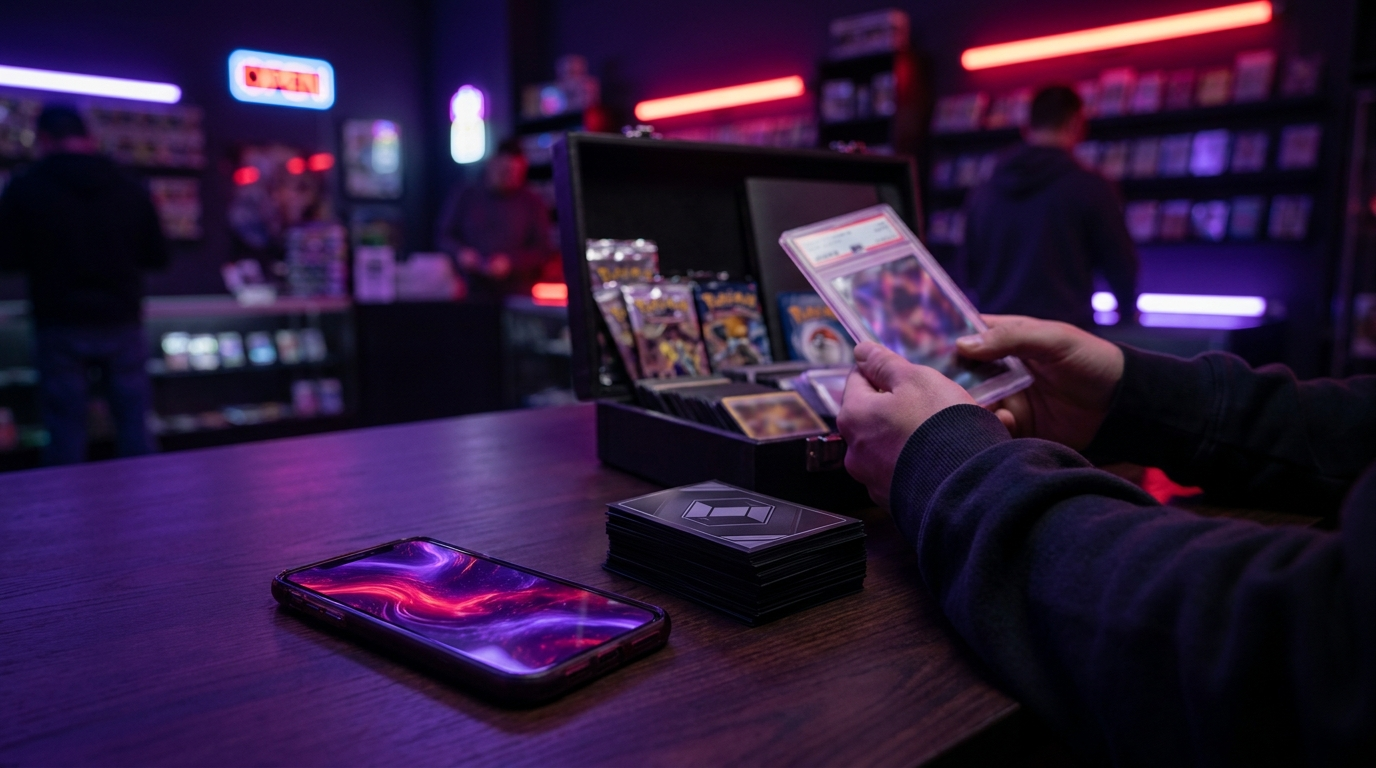
Since it launched in late 2024, Pokémon TCG Pocket has pulled off something remarkable: it introduced tens of millions of people to card collecting who had never touched a sleeve or a toploader. The mobile app is slick, generous and dangerously moreish — and it’s left a lot of players asking the obvious question: should I get into the real thing, stick to digital, or try to do both?
As a physical card shop, you might expect us to trash the app. We won’t, because it doesn’t deserve it: Pocket is a genuinely good product, and honestly one of the best onboarding tools the physical hobby has ever had. But the two experiences are more different than they look, and the differences are exactly what should drive your decision.
Here’s our honest comparison — what Pocket does brilliantly, what it can’t do at all, what each actually costs, and a sensible path if the app has you eyeing real cardboard.
Credit where due. Pokémon TCG Pocket nails the moment-to-moment joy of collecting: two free packs a day, gorgeous card scans, and the ‘immersive’ 3D cards that animate artwork in ways paper never could. The friction is zero — no shuffling to a shop, no sold-out releases, no storage boxes. Its streamlined battle mode is quick and approachable in a way the full tabletop game isn’t, and the social features (showcase binders, group pack openings, trading) capture a surprising amount of the hobby’s community feel.
It’s also, at the free tier, the cheapest possible way to find out whether card collecting scratches an itch for you. Plenty of our customers started exactly there.
And it keeps moving: regular new digital expansions, limited-time events and a steady drip of features mean the app rarely goes stale. The digital sets even mirror the physical hobby’s rhythms — chase cards, rarity tiers, that familiar ‘one more pack’ pull — which is precisely why it converts so many players into collectors.
Now the other side of the ledger. When you ‘pull’ a card in Pocket, what you own is an entry in a database governed by a licence agreement. You can’t sell it, can’t trade it outside the app’s narrow system, can’t slab it, display it on a shelf, or hand it to your kid in twenty years. If the service ever sunsets — and every digital service eventually does — the collection goes with it.
Physical cards are property. They carry real market value, they can be graded and insured, and the sensory side — the foil under shop lights, the smell of a fresh pack, the weight of a loaded binder — is a huge part of why this hobby has survived thirty years. There’s also permanence of a subtler kind: a physical collection is a record of your taste and your era, not a live-service account. Digital rents you the experience; physical sells you the object.
The social difference is just as real. Pocket’s community lives behind screens; the physical hobby happens across counters and card-show tables — trades negotiated face to face, pulls celebrated out loud, friendships that started over a binder page. Handing a spare holo to a wide-eyed kid at a trade night simply has no digital equivalent, and we’d argue moments like that are the actual product this hobby sells.
Watch outDigital cards are licensed, not owned. You cannot sell them, insure them or take them anywhere outside the app, and if the service is ever switched off the collection goes with it. Spend on Pocket the way you would spend on any game — for the play, never as an asset.
Money is where the comparison gets interesting, so let’s be straight about it:
| Option | Cost | Best for |
|---|---|---|
| Pocket, free tier | £0 | Trying collecting at zero risk — two packs a day, but progress is slow and chase cards can take months of luck |
| Pocket, paying | Around £8–£10 a month, plus whatever pack hourglasses swallow | Daily play and convenience, accepting that heavy spending buys assets you can never resell |
| Physical, casual | Roughly £10–£20 a month | A real, permanent collection at a similar monthly cost to Pocket’s paid tier |
| Physical, committed | ETBs, booster boxes and singles, scaling with your budget | Ownership — packs are consumption, but singles swap money for value you keep |
The honest summary: at low budgets the app is cheaper; at equal budgets, physical leaves you with assets, and digital leaves you with an account. Neither is wrong — they’re just different purchases.
One trap to name explicitly: microtransaction drift. App spending arrives in painless £2 and £8 sips that never feel like collecting money, and plenty of players discover they’ve spent ETB money on hourglasses without a single card to show for it. Whichever side you lean, set a monthly figure and count all of it — digital included.
Collector’s tipRun one hobby budget covering both sides. Count app spending in the same monthly figure as packs and singles, and the trade-off between a premium pass and a real Elite Trainer Box becomes an obvious choice rather than an invisible one.
If the app has done its job and you’re curious about real cards, don’t start by panic-buying whatever’s hyped. A sensible first month looks like this:
We’ve written a full beginner’s guide to collecting that expands on all of this, and our shop carries starter-friendly product year-round — we’re always happy to point first-timers at the sensible options rather than the expensive ones.
A tip that smooths the transition: let your Pocket favourites choose your first physical target. If you found yourself grinding for a particular Eeveelution or staring at one set’s artwork in the app, that enthusiasm transfers — and a first binder built around cards you already love beats a random pile of hyped product every time.
No. Digital cards are licensed entries in the app’s database, tradeable only within its own narrow system, and they carry no resale value outside it.
Yes, at the free tier, which gives two packs a day. The optional premium pass runs around £8–£10 a month at the time of writing.
It is one of the best. The app teaches rarity, artwork and the pack-opening ritual at no cost, and the sets you love in Pocket usually point straight at what you will enjoy collecting for real.
At low budgets the app wins outright. At equal spend, physical is better value in the sense that you keep something resellable at the end of it.
No. They cannot be graded, insured or sold, and their value ends with your account.
Here’s the quiet truth the ‘versus’ framing misses: most collectors we know run both. Pocket is the lunch-break hobby — free packs, quick battles, zero admin. Physical is the weekend hobby — set building, binder sessions, card shows, the community at the counter. The app even acts as a scouting tool: sets and artwork you love in Pocket usually point straight at what you’ll enjoy collecting for real. The two sides feed each other in the other direction too — physical collectors use the app to preview artwork before buying singles, and to scratch the pack-opening itch on days the budget says no. Official news for both sides lives in one place at pokemon.com.
The takeaway: Pocket is a brilliant game about collecting; physical cards are the real thing. If you want convenience and zero cost, stay digital and enjoy it guilt-free. If you want ownership, permanence and a hobby you can hold, the physical side is waiting — and if you’re not sure, do what most of us do and keep a foot in each. For a nudge on which sets suit a first real purchase, join our mailing list — beginner-friendly restocks are exactly the kind of thing we flag.
UK card shows explained: how the circuit works, what to expect at your first event, haggling etiquette and how to spot good deals. Meet the hobby.
Pokémon card trading is the best free fun in the hobby — until a bad trade stings. Value trades fairly, avoid scams online and trade with confidence.

Are Pokémon tins worth buying? We break down the tin line-up, mini tins vs full tins, the value maths and when a tin is genuinely the right buy.