
UK Card Shows & Events: Where Collectors Actually Meet
UK card shows explained: how the circuit works, what to expect at your first event, haggling etiquette and how to spot good deals. Meet the hobby.

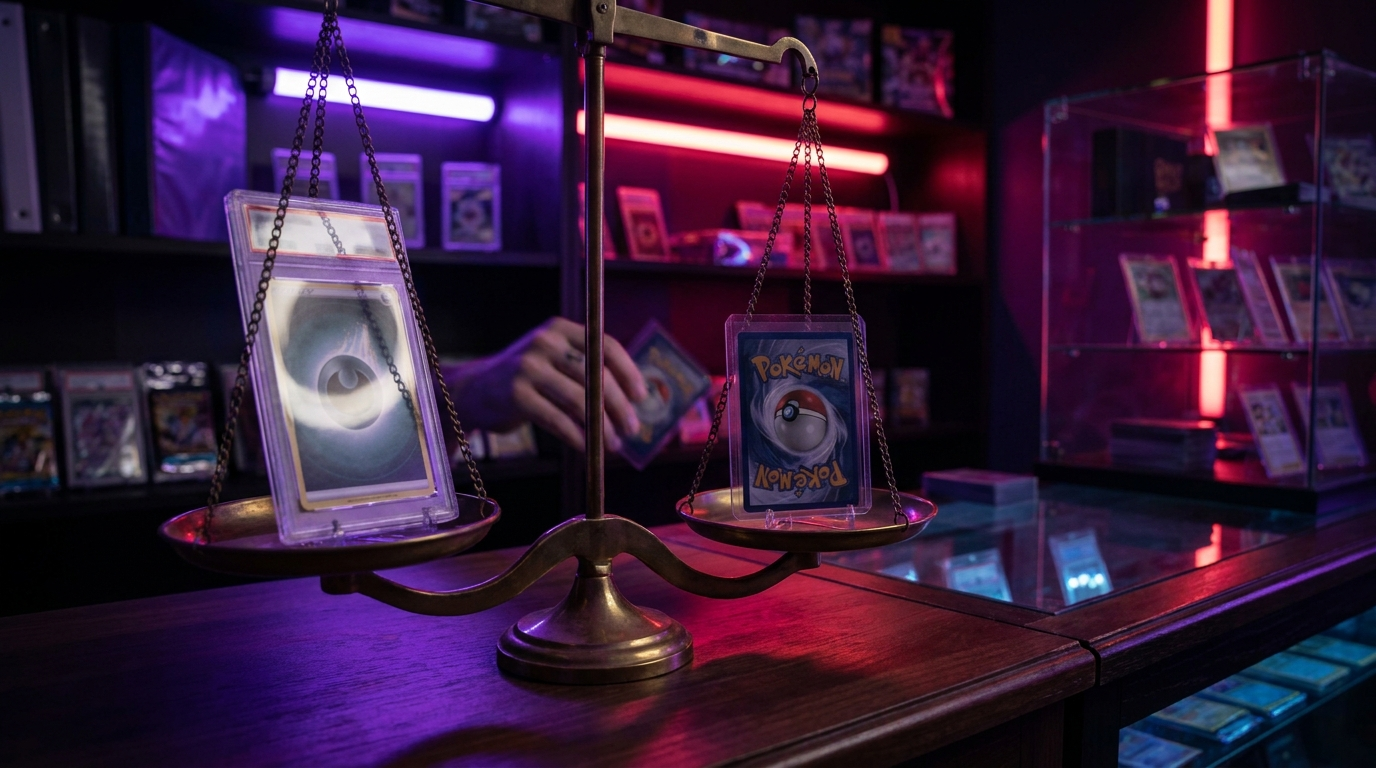
Pokémon card grading in the UK has gone from a niche habit to something almost every collector considers at some point. Slabs dominate social feeds, graded sales set the headline prices, and it’s easy to feel like every decent pull should be boxed up and posted off. We’d gently push back on that.
Grading is a paid service with a months-long turnaround, and for the majority of cards it either loses you money or breaks even at best. For the right cards, though, it genuinely adds value — sometimes a lot of it. The difference between the two outcomes is not luck. It’s arithmetic.
This guide walks through that arithmetic: what grading really costs from the UK, when it adds value, when it destroys it, and the simple rule of thumb we use ourselves before anything leaves the building.

Every grading decision comes down to one comparison:
Expected graded value minus (raw value + grading fee + postage and insurance + months of waiting). If that number isn’t comfortably positive, don’t send the card.
Two parts of that equation catch people out. The first is expected graded value. You are not paying for the PSA 10 price — you’re paying for a spread of possible outcomes. If a card has, say, a one-in-three chance of a 10 and mostly comes back a 9, your expected value is much closer to the 9 price than the 10 price. Be brutally honest about this before you post anything.
The second is the all-in cost. A headline fee of £15–£25 per card (typical for standard tiers at the time of writing) quickly grows once you add tracked and insured postage, any middleman or group-submission charges for services like PSA, and return shipping. For a single card sent on its own, the true cost can be half as much again as the fee itself. UK-based services such as ACE Grading cut the postage and customs sting considerably, which is exactly why they’ve grown so quickly here.
Service choice tilts the maths as well. PSA slabs generally command the strongest resale premiums worldwide, so for expensive cards the extra cost and wait of a PSA submission often pays for itself. For mid-value cards, a UK grader’s lower all-in cost can turn a marginal submission into a sensible one, even if the slab resells for slightly less. And whichever service you use, tiers matter: paying for an express tier on a £60 card is how profitable submissions quietly become unprofitable ones. Match the service and speed to the card, not to your impatience.
Collector’s tipSubmit in batches rather than one card at a time. Tracked, insured postage and handling charges are largely fixed per parcel, so spreading them across five or ten cards is the easiest way to cut the all-in cost per card — and it is often what turns a marginal submission into a sensible one.
Grading earns its keep in a few specific situations:
Now the uncomfortable list. Grading actively loses money when:
There’s also a quieter value-killer worth understanding: population reports. Modern sets are printed in enormous numbers, and graders publish exactly how many copies of each card they’ve slabbed at each grade. When ten thousand PSA 10s of a card already exist, a 10 stops being special — and prices behave accordingly. Before submitting any modern card, glance at its pop report and at how many graded copies are currently listed for sale. A high population plus a busy market means the premium you’re chasing may already be draining away by the time your submission comes back.
If you’re unsure where your card sits, our full guide on how to grade Pokémon cards in the UK covers the services, tiers and process from start to finish.
Before any card goes in a submission pile, put it through this five-minute inspection — ideally under a bright, cool LED lamp:
Cards that fail two or more checks almost never justify a submission on financial grounds.
Watch outNever try to improve a card before submitting it. Cleaning surfaces, trimming edges and pressing out a bend are all detectable, and a card flagged as altered comes back with a black label or not at all — worth far less than the honest grade you started with.

Prices move constantly, so treat these as illustrations of the method rather than quotes — and always check recent sold listings on eBay before deciding. The maths, not the numbers, is the point.
Example 1: a modern Special Illustration Rare. Say the card sells raw for around £120, graded 10s fetch roughly £250 and 9s around £140. All-in grading cost: £30. If your honest assessment gives a 40% chance of a 10 and 60% chance of a 9, your expected graded value is about £184. Minus the £30 cost, you’re roughly £34 ahead of raw — worth it, but only because the card was clean enough to have a real shot at the top grade.
Example 2: a £15 modern ex. Even a guaranteed 10 at, say, £45 barely clears the £30 all-in cost — and 10s are never guaranteed. A 9 here is worth about the same as the raw card. Expected outcome: a loss. This is most modern cards, and it’s why bulk-grading rarely pays.
Example 3: a played vintage holo. A Base Set holo worth £80 raw might bring £120–£150 in a mid-grade slab, because authentication removes buyer doubt. Spend £30, gain £40–£70 of certainty premium. Vintage flips the usual logic: condition matters less, authenticity matters more.
One more variable: timing. Graded prices for a hot set are usually highest in the weeks after release, when supply of slabs is thin — but that’s precisely when grading queues are longest, so your card comes back after the peak. Run the maths on today’s prices, then ask what the market will plausibly look like two or three months out when the slab actually lands. If the answer is “cooler”, shade your expected values down before deciding.
Standard tiers run roughly £15–£25 a card, but the number that matters is the all-in cost: add tracked insured postage both ways plus any submission or handling charge and around £30 a card is realistic. UK-based graders cut that considerably by removing international postage and customs.
One to three months is typical for standard tiers, and longer after a hyped release when queues build. Express tiers are faster but rarely justify the extra on anything but genuinely expensive cards.
PSA slabs command the strongest resale premiums worldwide, so they usually win on expensive cards. For mid-value cards a UK grader’s lower all-in cost often makes the maths work where a PSA submission would not.
Almost never. Even a perfect 10 rarely returns the £25–£35 all-in cost, and a 9 is typically worth about the same as the raw card.
It can. A modern card in an 8 slab often sells for less than the same card raw, because the slab certifies flaws a buyer might otherwise overlook. Vintage is the exception, where authentication carries value at almost any grade.
After all the spreadsheets, we run on one line: grade a card when the realistic uplift is at least double the all-in cost, or when authentication or preservation is the genuine goal. If a submission only makes sense in the best-case grade, it doesn’t make sense.
And remember there’s no deadline. A raw card in a sleeve and toploader loses nothing by waiting six months while you watch prices and grade populations settle — something worth doing after every hyped set, as our PSA grading UK guide explains in more detail. If you’d like our honest take on the market each week, including when grading trends shift, join the TCG Smiths mailing list — no hype, just the numbers that matter.
UK card shows explained: how the circuit works, what to expect at your first event, haggling etiquette and how to spot good deals. Meet the hobby.

Pokémon card trading is the best free fun in the hobby — until a bad trade stings. Value trades fairly, avoid scams online and trade with confidence.

Are Pokémon tins worth buying? We break down the tin line-up, mini tins vs full tins, the value maths and when a tin is genuinely the right buy.